 Add to Chrome
 Add to Firefox
 Add to Edge
ResearchMath-14K: Scaling Research-Level Mathematics via Agents
May 27, 2026
The frontier of mathematics is defined by problems whose solutions are not yet known, yet it remains unclear whether language models can meaningfully engage with such problems without human intervention. A major obstacle is the lack of large-scale research-level math datasets. To this end, we introduce ResearchMath-14k, a set of $14{,}056$ problems curated from academic sources via a multi-agent pipeline, making it the largest collection of research-level mathematical problems to date. We further generate ResearchMath-Reasoning, $220$K teacher trajectories from two open models, where we observe recurring avoidance behaviors such as non-attempts and fabricated references. Interestingly, across eight open-weight models, newer generations produce $5.6\times$ more references and $5.0\times$ more fake references per trace. After agentic filtering of ResearchMath-Reasoning, fine-tuning Qwen3 models from 4B to 30B parameters improves over base models by $9.2$ points on average. This shows that filtered open-problem attempts can provide useful supervision even without fully correct reasoning traces. We make ResearchMath-14k publicly available for future works on research-level mathematical reasoning.

Investigating Counterfactual Unfairness in LLMs towards Identities through Humor
Apr 20, 2026Humor holds up a mirror to social perception: what we find funny often reflects who we are and how we judge others. When language models engage with humor, their reactions expose the social assumptions they have internalized from training data. In this paper, we investigate counterfactual unfairness through humor by observing how the model's responses change when we swap who speaks and who is addressed while holding other factors constant. Our framework spans three tasks: humor generation refusal, speaker intention inference, and relational/societal impact prediction, covering both identity-agnostic humor and identity-specific disparagement humor. We introduce interpretable bias metrics that capture asymmetric patterns under identity swaps. Experiments across state-of-the-art models reveal consistent relational disparities: jokes told by privileged speakers are refused up to 67.5% more often, judged as malicious 64.7% more frequently, and rated up to 1.5 points higher in social harm on a 5-point scale. These patterns highlight how sensitivity and stereotyping coexist in generative models, complicating efforts toward fairness and cultural alignment.
Right at My Level: A Unified Multilingual Framework for Proficiency-Aware Text Simplification
Apr 07, 2026Text simplification supports second language (L2) learning by providing comprehensible input, consistent with the Input Hypothesis. However, constructing personalized parallel corpora is costly, while existing large language model (LLM)-based readability control methods rely on pre-labeled sentence corpora and primarily target English. We propose Re-RIGHT, a unified reinforcement learning framework for adaptive multilingual text simplification without parallel corpus supervision. We first show that prompting-based lexical simplification at target proficiency levels (CEFR, JLPT, TOPIK, and HSK) performs poorly at easier levels and for non-English languages, even with state-of-the-art LLMs such as GPT-5.2 and Gemini 2.5. To address this, we collect 43K vocabulary-level data across four languages (English, Japanese, Korean, and Chinese) and train a compact 4B policy model using Re-RIGHT, which integrates three reward modules: vocabulary coverage, semantic preservation, and coherence. Compared to the stronger LLM baselines, Re-RIGHT achieves higher lexical coverage at target proficiency levels while maintaining original meaning and fluency.
Random Is Hard to Beat: Active Selection in online DPO with Modern LLMs
Apr 03, 2026Modern LLMs inherit strong priors from web-scale pretraining, which can limit the headroom of post-training data-selection strategies. While Active Preference Learning (APL) seeks to optimize query efficiency in online Direct Preference Optimization (DPO), the inherent richness of on-policy candidate pools often renders simple Random sampling a surprisingly formidable baseline. We evaluate uncertainty-based APL against Random across harmlessness, helpfulness, and instruction-following settings, utilizing both reward models and LLM-as-a-judge proxies. We find that APL yields negligible improvements in proxy win-rates compared to Random. Crucially, we observe a dissociation where win-rate improves even as general capability -- measured by standard benchmarks -- degrades. APL fails to mitigate this capability collapse or reduce variance significantly better than random sampling. Our findings suggest that in the regime of strong pre-trained priors, the computational overhead of active selection is difficult to justify against the ``cheap diversity'' provided by simple random samples. Our code is available at https://github.com/BootsofLagrangian/random-vs-apl.
vla-eval: A Unified Evaluation Harness for Vision-Language-Action Models
Mar 14, 2026Vision Language Action VLA models are typically evaluated using per benchmark scripts maintained independently by each model repository, leading to duplicated code, dependency conflicts, and underspecified protocols. We present vla eval, an open source evaluation harness that decouples model inference from benchmark execution through a WebSocket msgpack protocol with Docker based environment isolation. Models integrate once by implementing a single predict() method; benchmarks integrate once via a four method interface; the full cross evaluation matrix works automatically. A complete evaluation requires only two commands: vla eval serve and vla eval run. The framework supports 13 simulation benchmarks and six model servers. Parallel evaluation via episode sharding and batch inference achieves a 47x throughput improvement, completing 2000 LIBERO episodes in about 18 minutes. Using this infrastructure, we conduct a reproducibility audit of a published VLA model across three benchmarks, finding that all three closely reproduce published values while uncovering undocumented requirements ambiguous termination semantics and hidden normalization statistics that can silently distort results. We additionally release a VLA leaderboard aggregating 657 published results across 17 benchmarks. Framework, evaluation configs, and all reproduction results are publicly available.
Judging What We Cannot Solve: A Consequence-Based Approach for Oracle-Free Evaluation of Research-Level Math
Feb 06, 2026Recent progress in reasoning models suggests that generating plausible attempts for research-level mathematics may be within reach, but verification remains a bottleneck, consuming scarce expert time. We hypothesize that a meaningful solution should contain enough method-level information that, when applied to a neighborhood of related questions, it should yield better downstream performance than incorrect solutions. Building on this idea, we propose \textbf{Consequence-Based Utility}, an oracle-free evaluator that scores each candidate by testing its value as an in-context exemplar in solving related yet verifiable questions. Our approach is evaluated on an original set of research-level math problems, each paired with one expert-written solution and nine LLM-generated solutions. Notably, Consequence-Based Utility consistently outperforms reward models, generative reward models, and LLM judges on ranking quality. Specifically, for GPT-OSS-120B, it improves Acc@1 from 67.2 to 76.3 and AUC from 71.4 to 79.6, with similarly large AUC gains on GPT-OSS-20B (69.0 to 79.2). Furthermore, compared to LLM-Judges, it also exhibits a larger solver-evaluator gap, maintaining a stronger correct-wrong separation even on instances where the underlying solver often fails to solve.
Do Language Models Associate Sound with Meaning? A Multimodal Study of Sound Symbolism
Nov 16, 2025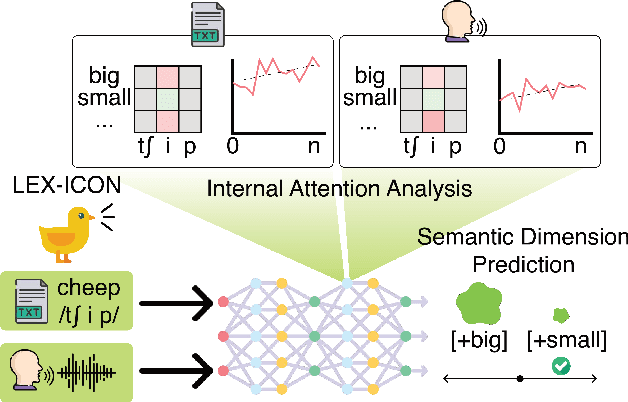

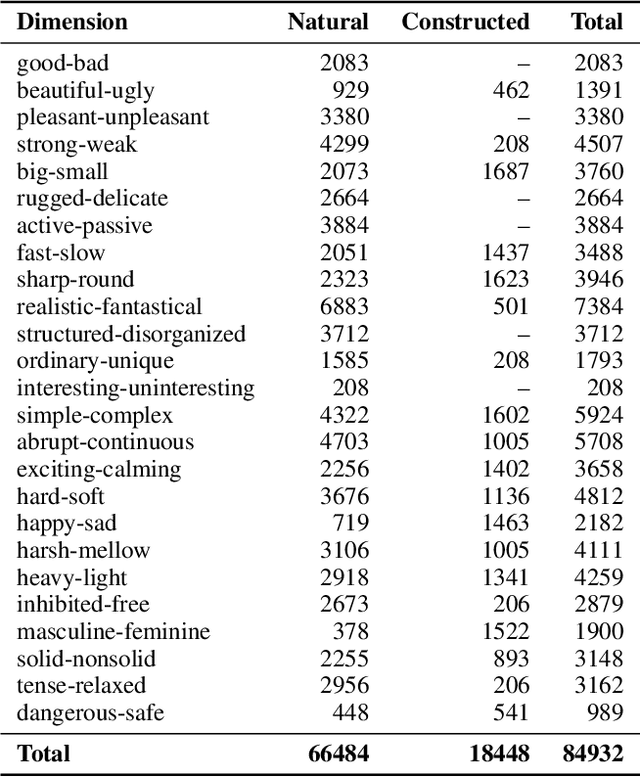
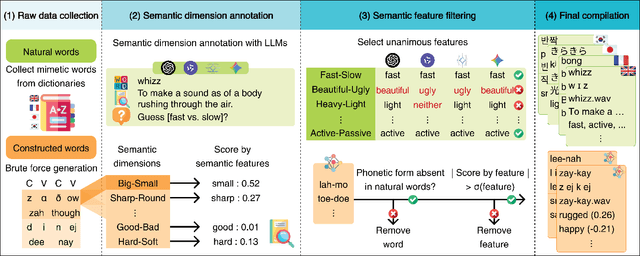
Sound symbolism is a linguistic concept that refers to non-arbitrary associations between phonetic forms and their meanings. We suggest that this can be a compelling probe into how Multimodal Large Language Models (MLLMs) interpret auditory information in human languages. We investigate MLLMs' performance on phonetic iconicity across textual (orthographic and IPA) and auditory forms of inputs with up to 25 semantic dimensions (e.g., sharp vs. round), observing models' layer-wise information processing by measuring phoneme-level attention fraction scores. To this end, we present LEX-ICON, an extensive mimetic word dataset consisting of 8,052 words from four natural languages (English, French, Japanese, and Korean) and 2,930 systematically constructed pseudo-words, annotated with semantic features applied across both text and audio modalities. Our key findings demonstrate (1) MLLMs' phonetic intuitions that align with existing linguistic research across multiple semantic dimensions and (2) phonosemantic attention patterns that highlight models' focus on iconic phonemes. These results bridge domains of artificial intelligence and cognitive linguistics, providing the first large-scale, quantitative analyses of phonetic iconicity in terms of MLLMs' interpretability.
What MLLMs Learn about When they Learn about Multimodal Reasoning: Perception, Reasoning, or their Integration?
Oct 02, 2025Multimodal reasoning models have recently shown promise on challenging domains such as olympiad-level geometry, yet their evaluation remains dominated by aggregate accuracy, a single score that obscures where and how models are improving. We introduce MathLens, a benchmark designed to disentangle the subskills of multimodal reasoning while preserving the complexity of textbook-style geometry problems. The benchmark separates performance into three components: Perception: extracting information from raw inputs, Reasoning: operating on available information, and Integration: selecting relevant perceptual evidence and applying it within reasoning. To support each test, we provide annotations: visual diagrams, textual descriptions to evaluate reasoning in isolation, controlled questions that require both modalities, and probes for fine-grained perceptual skills, all derived from symbolic specifications of the problems to ensure consistency and robustness. Our analysis reveals that different training approaches have uneven effects: First, reinforcement learning chiefly strengthens perception, especially when supported by textual supervision, while textual SFT indirectly improves perception through reflective reasoning. Second, reasoning improves only in tandem with perception. Third, integration remains the weakest capacity, with residual errors concentrated there once other skills advance. Finally, robustness diverges: RL improves consistency under diagram variation, whereas multimodal SFT reduces it through overfitting. We will release all data and experimental logs.
Zero-shot Multimodal Document Retrieval via Cross-modal Question Generation
Aug 23, 2025Rapid advances in Multimodal Large Language Models (MLLMs) have expanded information retrieval beyond purely textual inputs, enabling retrieval from complex real world documents that combine text and visuals. However, most documents are private either owned by individuals or confined within corporate silos and current retrievers struggle when faced with unseen domains or languages. To address this gap, we introduce PREMIR, a simple yet effective framework that leverages the broad knowledge of an MLLM to generate cross modal pre questions (preQs) before retrieval. Unlike earlier multimodal retrievers that compare embeddings in a single vector space, PREMIR leverages preQs from multiple complementary modalities to expand the scope of matching to the token level. Experiments show that PREMIR achieves state of the art performance on out of distribution benchmarks, including closed domain and multilingual settings, outperforming strong baselines across all retrieval metrics. We confirm the contribution of each component through in depth ablation studies, and qualitative analyses of the generated preQs further highlight the model's robustness in real world settings.
InfoCausalQA:Can Models Perform Non-explicit Causal Reasoning Based on Infographic?
Aug 08, 2025Recent advances in Vision-Language Models (VLMs) have demonstrated impressive capabilities in perception and reasoning. However, the ability to perform causal inference -- a core aspect of human cognition -- remains underexplored, particularly in multimodal settings. In this study, we introduce InfoCausalQA, a novel benchmark designed to evaluate causal reasoning grounded in infographics that combine structured visual data with textual context. The benchmark comprises two tasks: Task 1 focuses on quantitative causal reasoning based on inferred numerical trends, while Task 2 targets semantic causal reasoning involving five types of causal relations: cause, effect, intervention, counterfactual, and temporal. We manually collected 494 infographic-text pairs from four public sources and used GPT-4o to generate 1,482 high-quality multiple-choice QA pairs. These questions were then carefully revised by humans to ensure they cannot be answered based on surface-level cues alone but instead require genuine visual grounding. Our experimental results reveal that current VLMs exhibit limited capability in computational reasoning and even more pronounced limitations in semantic causal reasoning. Their significantly lower performance compared to humans indicates a substantial gap in leveraging infographic-based information for causal inference. Through InfoCausalQA, we highlight the need for advancing the causal reasoning abilities of multimodal AI systems.